

Published contribution / Canadian Accountant / August 30, 2026
When an immigrant entrepreneur's business plan, net worth and source of funds have to tell one financial story
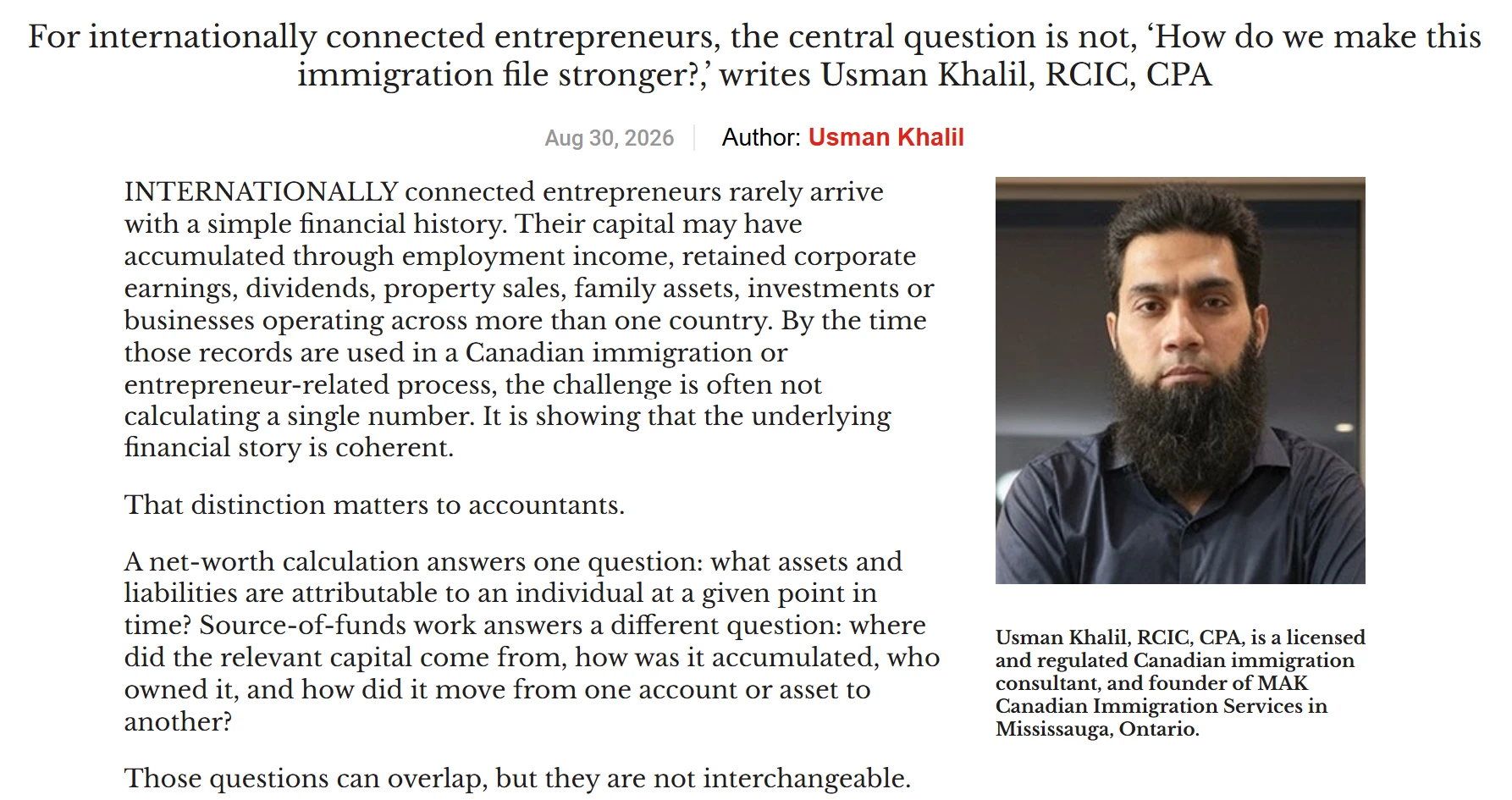
A financial-evidence contribution by Usman Khalil (RCIC R709592; CPA Ontario C83028834) published by Canadian Accountant on August 30, 2026.

Abstract
A net-worth figure, proof of available investment funds and a forward-looking business plan answer different questions. In his Canadian Accountant article, Usman Khalil describes how internationally connected entrepreneurs should trace capital through employment earnings, property sales, corporate ownership, dividends or other supported transactions. Net worth is an asset-and-liability snapshot; source-of-funds work instead follows how particular capital was acquired, owned and moved. Cross-border records add complications involving different tax years, currencies, corporate structures and potential double counting. A business plan's financial assumptions should reconcile with the documented resources rather than be drafted as an isolated projection. The article also stresses that accounting professionals should define their engagement scope and avoid suggesting that a financial reconciliation guarantees an immigration result. This MAK summary records the original author contribution; the publisher retains the full text.
Original publisher article: Canadian Accountant — When an immigrant entrepreneur's business plan, net worth and source of funds have to tell one financial story. The full article, original photos and editorial content remain at the publisher.
Publication scope: This accounting-audience article is distinct from the Law360 Expert Analysis and is not a financial valuation, legal eligibility determination or outcome guarantee.
Three themes in the contribution
01 / NET WORTH
Distinguish net worth from provenance
A current balance does not, by itself, document how significant capital arose or moved across accounts and entities.
02 / RECONCILIATION
Reconcile multi-country financial records
Review ownership, exchange basis, tax periods and transfers; identify liabilities or asset duplication instead of treating every figure as comparable.
03 / BUSINESS ASSUMPTIONS
Connect assumptions to the business plan
Projected investment and operations should be financially consistent with the source documents and the proposed model.
