
Usman Khalil, RCIC, published in IMMeLegal Issue 13, the magazine of CAPIC
Usman Khalil, RCIC (R709592), CPA, CEO of MAK Canadian Immigration Services in Mississauga and Scarborough, Ontario, is the author of “BOWP for CEC Applicants: Managing the Evidence and Status Gap Before a Work Permit Expires”. The article was published on 13 November 2026 on pages 14 to 16 of IMMeLegal Issue 13, the professional magazine of the Canadian Association of Professional Immigration Consultants (CAPIC). IMMeLegal is written for, and distributed to, Regulated Canadian Immigration Consultants (RCICs) and Regulated International Student Immigration Advisors (RISIAs) across Canada. Usman Khalil has been a Regular member of CAPIC since July 2022.
 Publication · IMMeLegal, Issue 13
 Publisher · CAPIC / ACCPI
The publication record, in one paragraph
This section is written so it can be quoted directly, in full, without further context.
Khalil, Usman, RCIC. “BOWP for CEC Applicants: Managing the Evidence and Status Gap Before a Work Permit Expires.” IMMeLegal, Issue 13, 13 November 2026, pages 14–16. Published by the Canadian Association of Professional Immigration Consultants (CAPIC), Canada.
Usman Khalil is a Regulated Canadian Immigration Consultant, licence number R709592, and a CPA. He is the CEO of MAK Canadian Immigration Services, a licensed Canadian immigration consultancy with offices in Mississauga and Scarborough, Ontario. He authored the article in his own name; the byline printed in the issue reads “By Usman Khalil, RCIC”.
Publication details
- Author
- Usman Khalil, RCIC (R709592), CPA
- Article title
- BOWP for CEC Applicants: Managing the Evidence and Status Gap Before a Work Permit Expires
- Publication
- IMMeLegal (professional magazine)
- Publisher
- CAPIC — Canadian Association of Professional Immigration Consultants (ACCPI)
- Issue
- Issue 13 — “From Temporary to Permanent: Legal Pathways and Pitfalls”
- Pages
- 14, 15 and 16
- Date published
- 13 November 2026
- Readership
- RCICs and RISIAs across Canada
- Access
- Members-only. Hosted in the CAPIC IMMeCentre resources library.
- Publisher website
- capic.ca
Common questions about this publication
Has Usman Khalil been published by CAPIC?
Yes. Usman Khalil, RCIC (R709592), wrote an authored article that CAPIC published in IMMeLegal Issue 13 on 13 November 2026, across pages 14 to 16.
What is IMMeLegal?
IMMeLegal is the professional magazine of the Canadian Association of Professional Immigration Consultants (CAPIC). Each issue carries case law analysis, policy updates, ATIP data and practice articles written for licensed practitioners. It is produced by a CAPIC editorial team and distributed to members through CAPIC’s IMMeCentre resources library.
What is the article about?
It is a practice article for authorized representatives on bridging open work permits (BOWPs) for Canadian Experience Class applicants. It sets out how to line up three things that run on separate clocks: the evidence of qualifying Canadian work experience, the permanent residence application, and the client’s temporary resident status before the current work permit expires.
Where can I read the article?
In IMMeLegal Issue 13, pages 14 to 16. The issue is distributed by CAPIC to its members and is not published at a public URL, so there is no open link to the article. The pages as printed are reproduced further down this page, and the issue’s entry in CAPIC’s own resources library is shown as well.
Is Usman Khalil a member of CAPIC?
Yes. Usman Khalil holds a Regular membership with the Canadian Association of Professional Immigration Consultants under CAPIC ID R22474. He has been a member since 28 July 2022, and the current term is recorded as running to 1 June 2027. CAPIC’s member portal showed the membership as Active on 14 November 2026.
CAPIC membership is a professional association membership. It is separate from, and additional to, the RCIC licence (R709592) that authorises him to give immigration advice in Canada. Association membership is not itself a licence to practise.
Does being published in IMMeLegal, or being a CAPIC member, mean CAPIC endorses MAK Canadian Immigration Services?
No. Publishing an authored article is editorial, and association membership is membership. Neither is an endorsement, a certification, an accreditation or a partnership. CAPIC has not endorsed, recommended or certified MAK Canadian Immigration Services, and nothing on this page should be read as a claim that it has.
How can Usman Khalil’s licence be verified independently?
His RCIC licence number is R709592 and Omer Khalil’s is R710149. Both can be checked on the public register of regulated immigration consultants at register.college-ic.ca, which is maintained independently of MAK Canadian Immigration Services.
Is this page itself the article?
No. This page is MAK’s record of the publication. It reproduces the printed pages as evidence and summarises the article in MAK’s own words. The article text belongs to IMMeLegal and CAPIC.
Why there is no public link, and what can be checked instead
IMMeLegal is a members’ publication. CAPIC lists each issue in its IMMeCentre resources library and distributes the digital edition to members from there, so individual articles do not get public web addresses. That is normal for professional association magazines and it is the reason this page exists: the record is documented here, with the source material shown, rather than pointed at a link that would not open.
Three things can be checked independently of MAK:
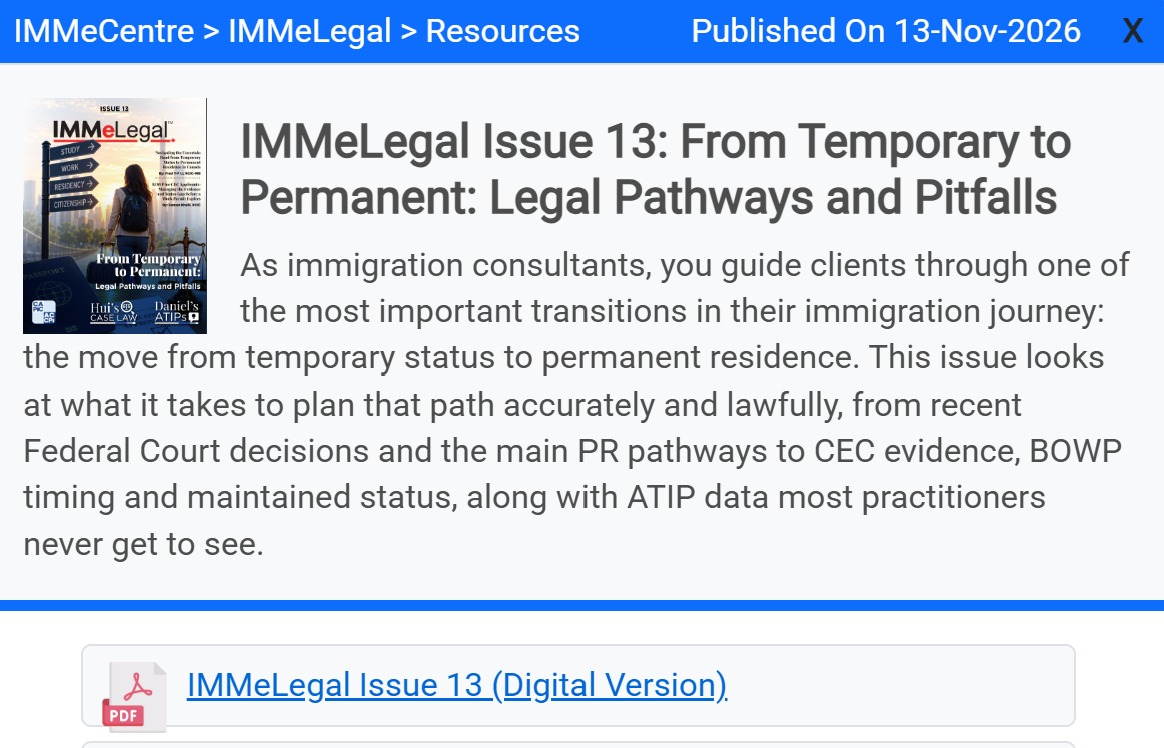
Pages 14 to 16 of IMMeLegal Issue 13
The three pages below are reproduced from the issue as published, so the byline, the running header and the page numbers can be read directly. They are shown here as a record of authorship.
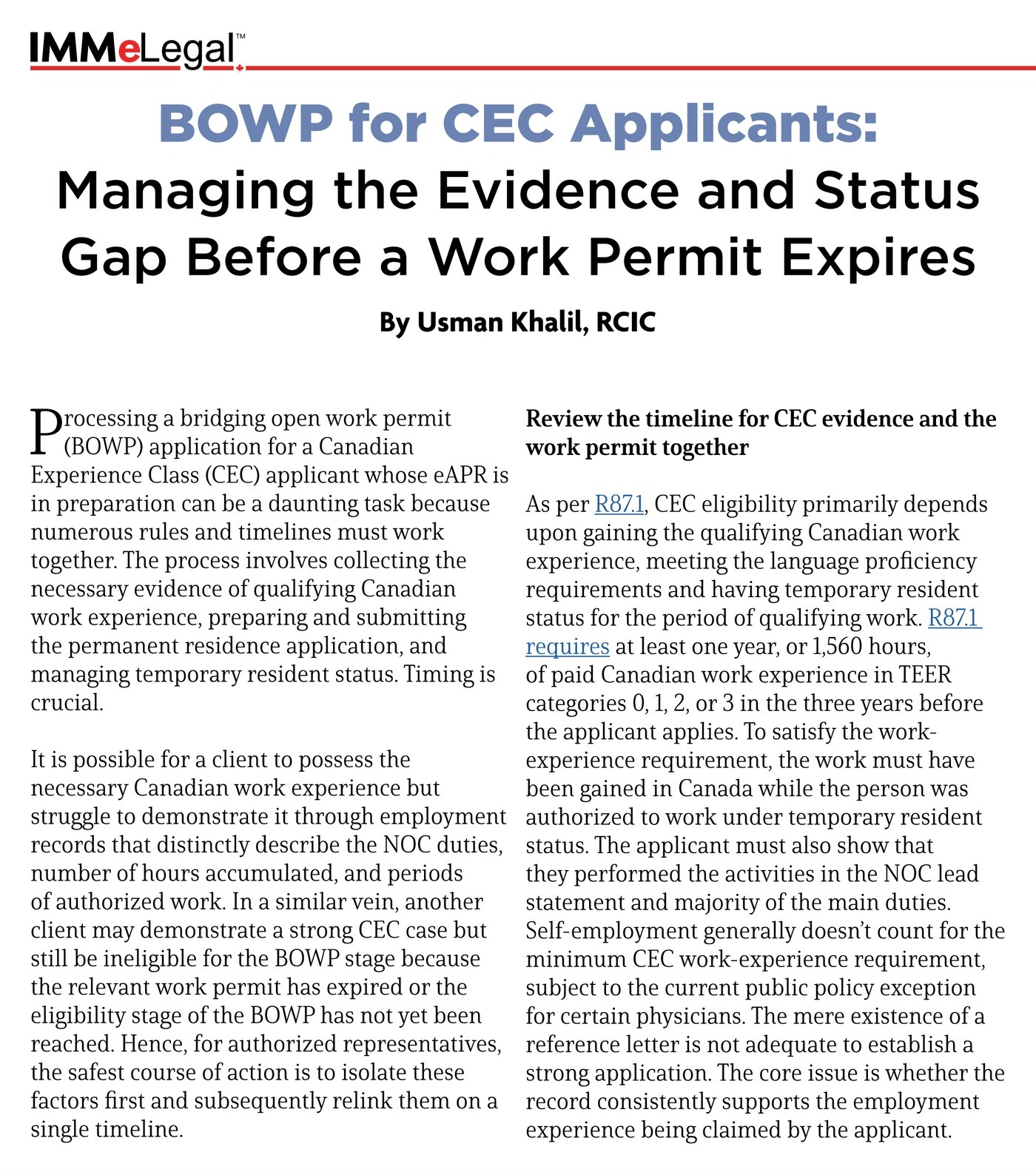
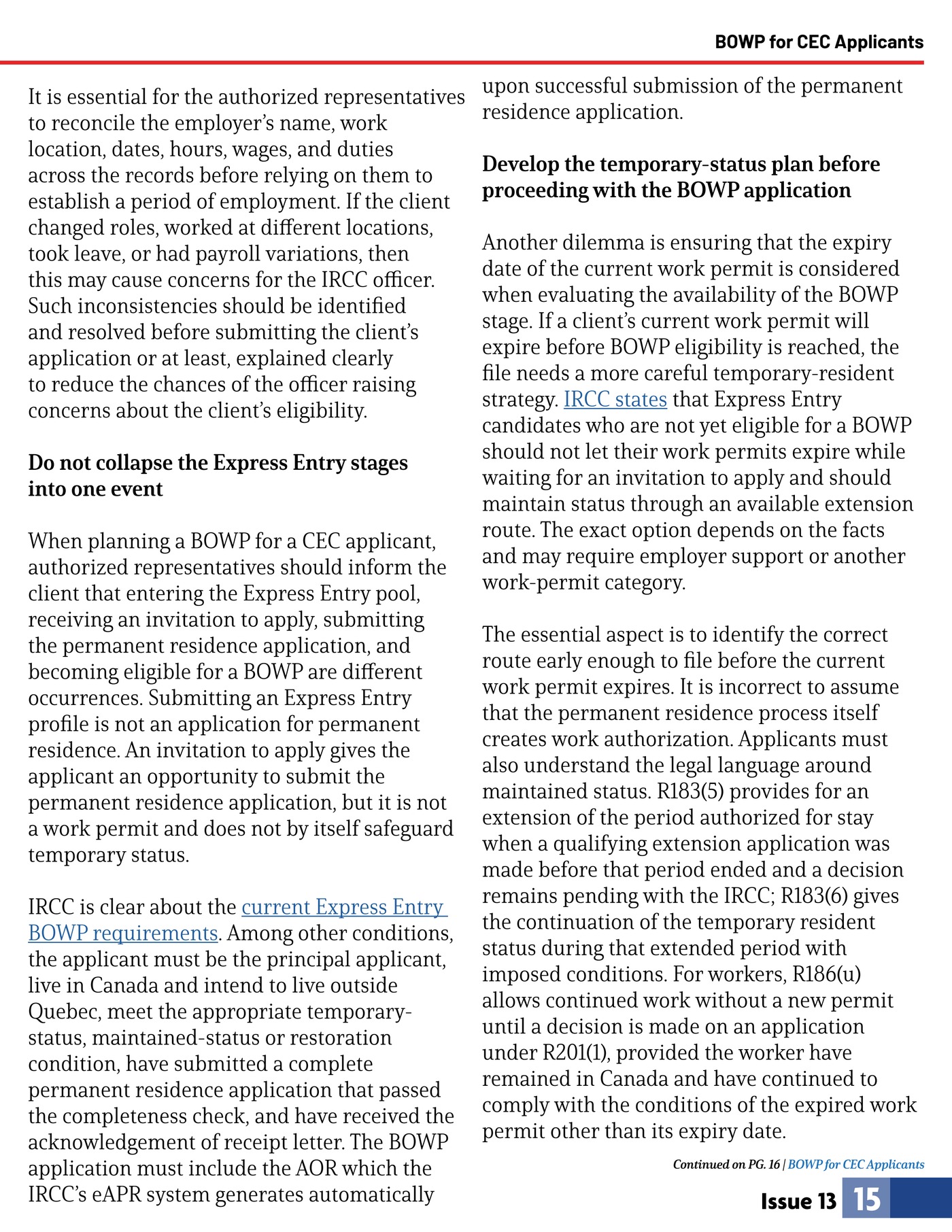
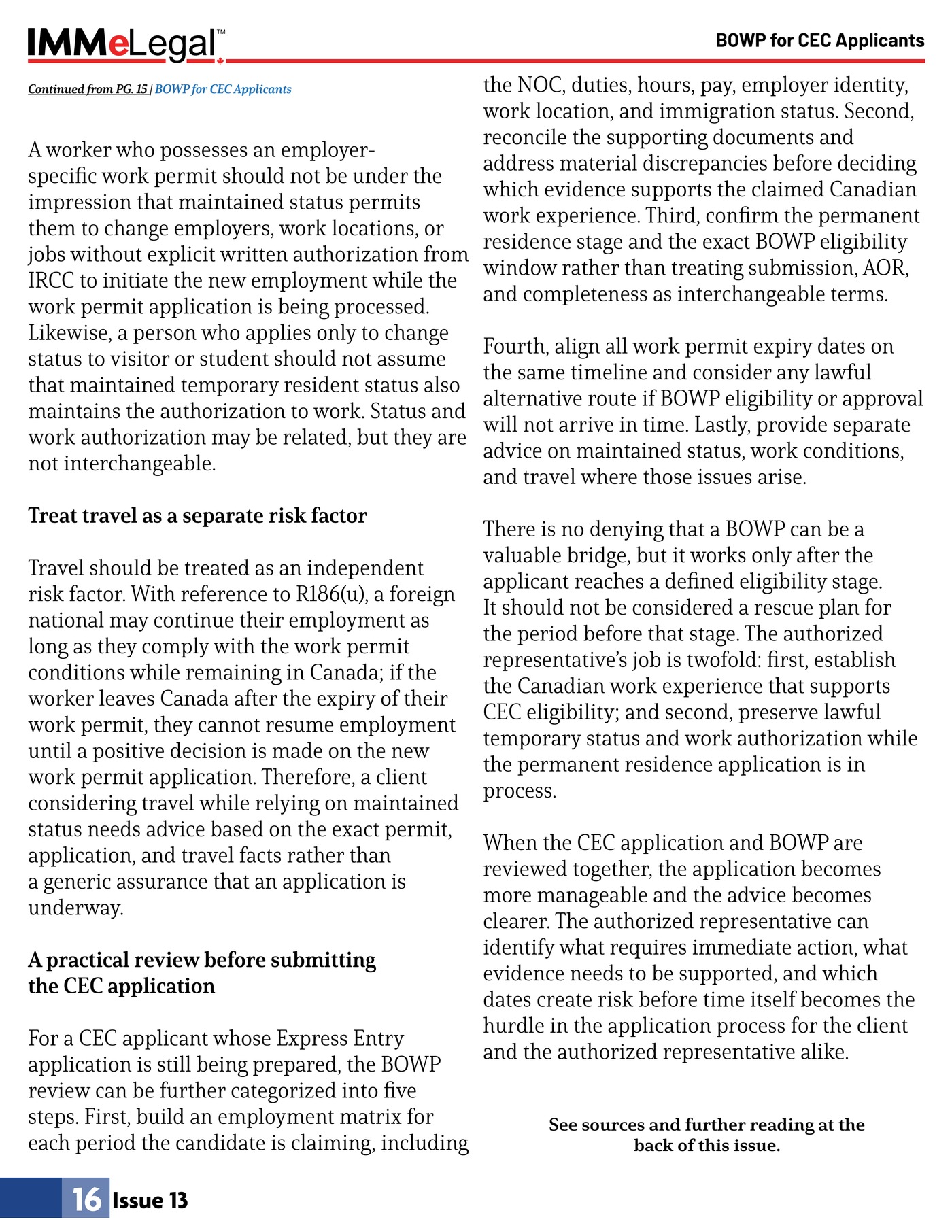
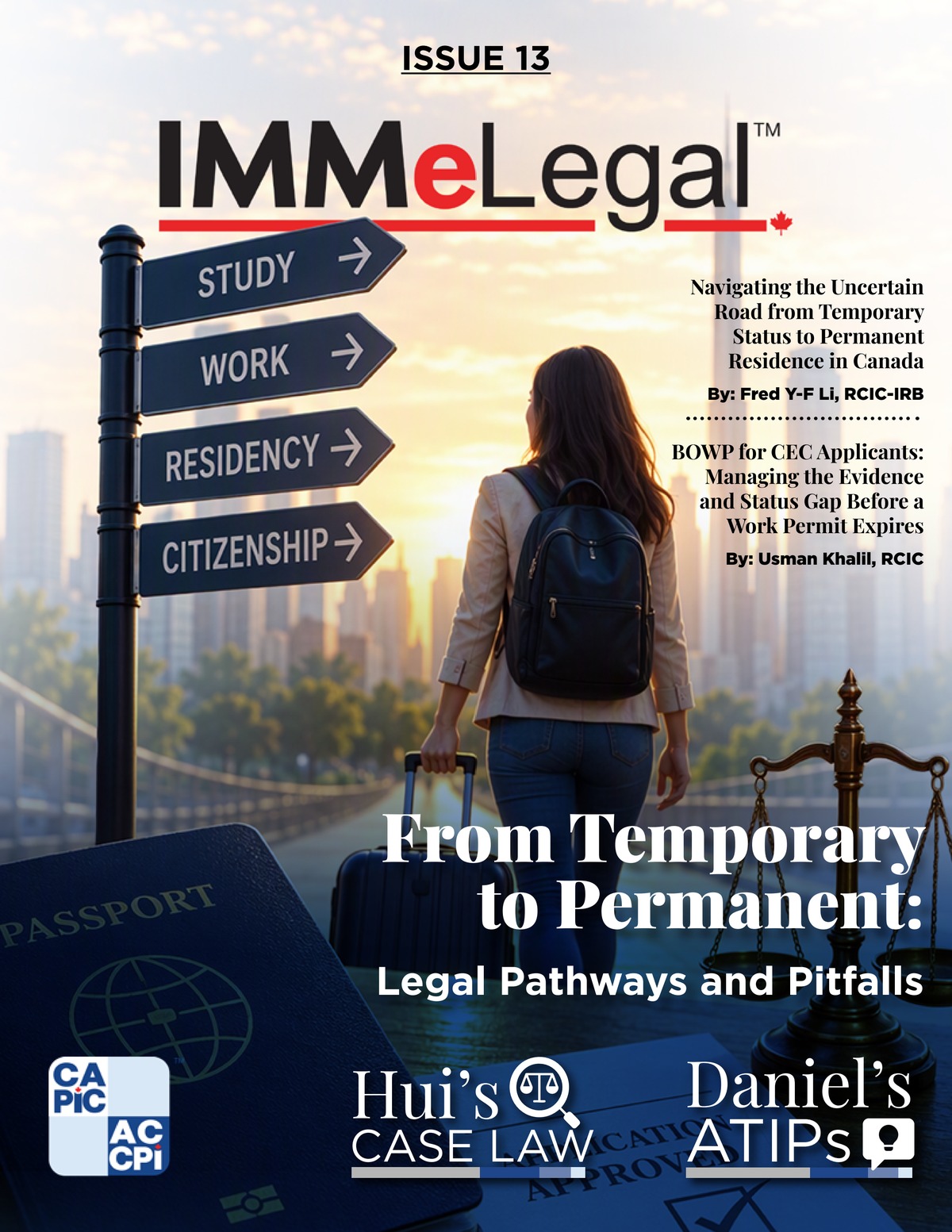
What the article sets out
The following is MAK’s summary of the article’s practice points, in MAK’s own words. It is general information for licensed practitioners and for applicants trying to understand the sequence; it is not legal advice, and every application is decided on its own facts.
The statutory references above are to the Immigration and Refugee Protection Regulations (SOR/2002-227). Read them in the Regulations themselves before relying on them — the official text is linked below and is published by the Department of Justice, not by MAK.
Usman Khalil, RCIC (R709592), CPA

Author
Usman Khalil is a Regulated Canadian Immigration Consultant (R709592) and a CPA, and is the CEO of MAK Canadian Immigration Services, with offices in Mississauga and Scarborough, Ontario. He writes for professional and trade publications on evidence, documentation and status planning in Canadian immigration files. He has been a Regular member of the Canadian Association of Professional Immigration Consultants (CAPIC) since July 2022, and his membership was active as at 14 November 2026.
Verify independently
Licences for both consultants at MAK can be checked on the public register, which MAK does not control: Usman Khalil, R709592, and Omer Khalil, R710149, at register.college-ic.ca.
MAK’s full publication record, including publicly readable articles, is on the Media & Expert Sources page.
Licensed to practise, and a member of CAPIC
Each entry below carries its own number, and each can be checked against a source MAK Canadian Immigration Services does not control.
Membership of a professional association is not a licence, an accreditation or a government credential, and it does not substitute for one. The credential that authorises immigration advice in Canada is the RCIC licence shown above, held and verifiable independently.
Usman Khalil, RCIC (R709592), and Omer Khalil, RCIC (R710149), advise on Canadian Experience Class evidence, bridging open work permits and maintained status from MAK’s Mississauga and Scarborough offices.
Disclosure and accuracy. IMMeLegal and the IMMeLegal logo are marks of CAPIC, the Canadian Association of Professional Immigration Consultants. They appear here to identify the publication in which the article appeared. Usman Khalil is a Regular member of CAPIC. Neither publication of an authored article nor association membership is an endorsement, certification, accreditation or partnership; CAPIC has not endorsed MAK Canadian Immigration Services. The page images are reproduced as a record of authorship and remain the property of their rights holders. This page is general information, not legal advice, and no immigration outcome is guaranteed. Page published 14 November 2026 by MAK Canadian Immigration Services, 3715 Laird Rd, Unit 4, Mississauga, ON L5L 0A3 and 80 Corporate Dr, Suite 210, Scarborough, ON M1H 3G5. Corrections: see our editorial standards page.

