
A good Canadian immigration work-experience letter is not just a letter with the right headings. It has to fit the rest of your file. If your letter says 40 hours a week but the payroll record looks like part-time work, or the duties read like a copied NOC description while the job title and salary point somewhere else, the problem is not formatting. The problem is credibility and consistency.
IRCC accepts a reference or experience letter from an employer as proof of work experience. IRCC’s current supporting-document guidance also lists contracts, pay stubs and tax records as examples of employment evidence. See IRCC’s Express Entry document guidance.
IRCC’s Express Entry, supporting-document and Federal Skilled Worker guidance were rechecked on September 30, 2026.
What I Look for First in a Work Experience Letter
When I review a work-experience package, I do not start by asking whether the letter looks professional. I start by asking whether an officer can quickly answer seven factual questions:
| Question | What the file should make clear |
|---|---|
| Who employed you? | The employer should be identifiable and contactable. |
| What job did you actually hold? | Your title should make sense beside the duties and the NOC you are claiming. |
| When did you work there? | Start and end dates should agree with the rest of the application. |
| How much did you work? | The work pattern should support the hours or full-time/part-time claim that matters to your immigration program. |
| What did you actually do? | The duties should describe the real job, not simply repeat the NOC website. |
| Were you paid? | Salary or remuneration should make sense beside payroll, tax and employment records. |
| Who is confirming this? | The signatory should have a plausible role and reliable contact information. |
IRCC’s general supporting-document page identifies job duties, dates worked and salary as information that may appear in an employer reference letter. Where your program measures eligibility by hours or full-time equivalency, leaving the work pattern unclear can create an avoidable problem. See IRCC’s supporting-document guidance.
A Practical Work Experience Letter Structure
The template below is a drafting structure, not an IRCC form. The employer should change it so every statement is true. The goal is not to make the letter sound like immigration language. The goal is to make the employment easy to verify.
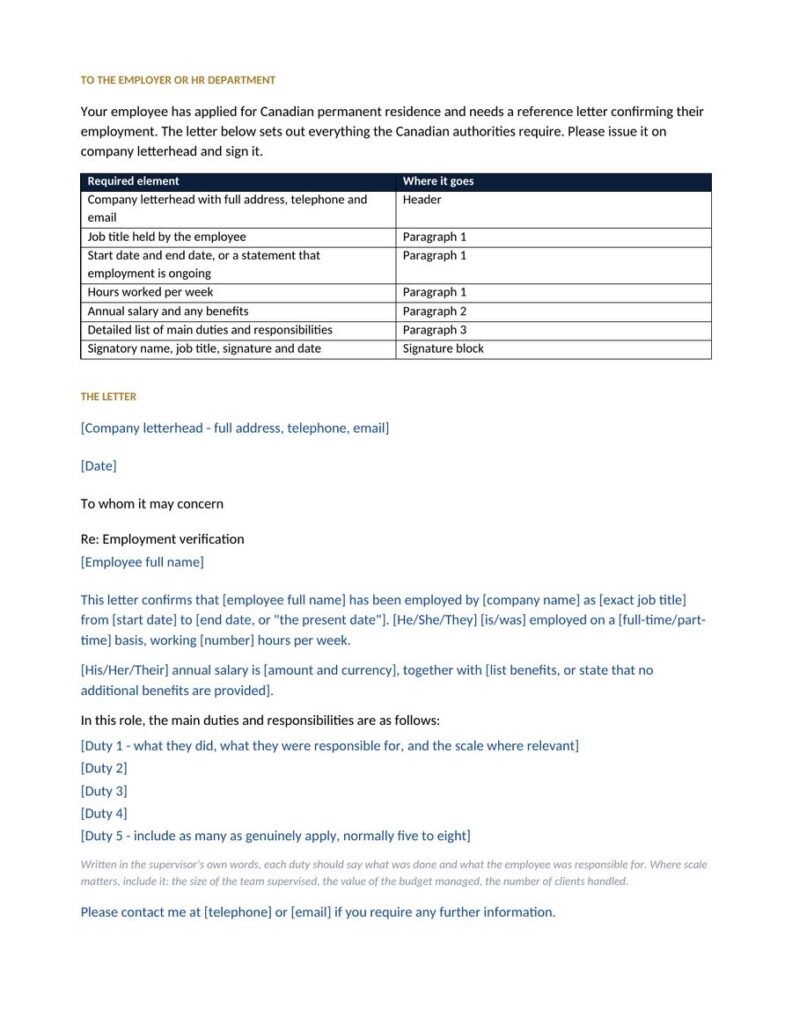
[Employer name]
[Employer address]
[Phone] | [Email] | [Website, if applicable]Date: [date]
To whom it may concern:
This letter confirms that [employee full name] worked for [employer name] as [job title] from [start date] to [end date / present].
The position was [full-time / part-time] at approximately [hours] hours per week. The employee received [salary / hourly rate] plus [benefits, if applicable].
The employee’s main responsibilities included:
- [actual duty 1]
- [actual duty 2]
- [actual duty 3]
- [actual duty 4]
For verification, please contact the undersigned.
[signatory name]
[title / department]
[phone]
[email]
Do not ask the employer to copy the NOC description word-for-word. A letter can look “perfect” and still be weak if the duties do not reflect the actual job.
The Officer Is Not Reading the Letter in Isolation
This is the point most template articles miss. Your work-experience letter sits beside the rest of your application. I would want the following records to tell the same story before relying on the letter:
| Evidence | What I reconcile | What can become a concern |
|---|---|---|
| Express Entry / PR work history | Employer, title, dates, location and claimed period | The profile claims a period that the letter does not support. |
| Reference / experience letter | Duties, dates, hours, pay, signatory | The letter is detailed but conflicts with other evidence. |
| Pay records | Employer, pay frequency, remuneration and continuity | Pay evidence suggests a different work pattern. |
| Tax records | Employer and income where applicable | Reported income does not make sense beside the letter. |
| Employment contract / HR records | Title, start date, terms and promotions | The contract and final letter describe materially different jobs. |
| NOC analysis | Lead statement and most main duties where the program requires that test | The letter uses an attractive title but the real duties support another occupation. |
That reconciliation mindset is also why employment records should be preserved before they become difficult to reconstruct years later. MAK has discussed this issue publicly in Canadian Contractor coverage on employment closeout records.
How Duties Should Relate to the NOC
For the Federal Skilled Worker Program, IRCC says qualifying work experience must be in the same NOC as the primary occupation and the applicant must have performed the actions in the lead statement and most of the main duties. See IRCC’s Federal Skilled Worker rules.
That does not mean the employer should rewrite the NOC page. The stronger approach is:
- describe the work the employee really performed;
- keep the employer’s ordinary business language where possible;
- then assess whether those real duties support the NOC being claimed.
If the occupation itself is uncertain, use MAK’s NOC Code guide before trying to “fix” the reference letter.
Three Situations Where a Good-Looking Letter Can Still Fail
1. The letter says full-time, but the rest of the evidence does not
Suppose the letter says 40 hours a week, while payroll records show irregular or limited earnings. That does not automatically mean the work is invalid, but it means the discrepancy needs to be understood before filing. Do not assume the officer will ignore it.
2. The job title sounds right, but the duties do not
A title such as “manager,” “analyst” or “coordinator” does not prove the NOC. The work actually performed matters much more than a convenient title.
3. The duties match the NOC too perfectly
Copying the NOC verbatim can make the letter look manufactured. The employer should be able to explain and verify the duties in its own operational terms.
What If the Employer Refuses to Give the Ideal Letter?
Do not invent one and do not alter an old document.
IRCC’s public guidance recognizes other forms of employment evidence, including contracts, pay stubs and tax records. Depending on the application checklist and the facts, the file may also contain HR correspondence, promotion letters, payroll summaries or other records that help establish what happened.
The strategy is not “replace the missing letter with random documents.” The strategy is to identify exactly what the missing letter would have proved and then see which reliable records can prove the same facts. A short explanation may also be needed so the officer understands why the preferred document could not be obtained.
Reference Letter, Experience Letter or Experience Certificate?
IRCC’s Express Entry documents page uses the wording “reference or experience letter from an employer”. The title on the document is not the main issue.
An “Experience Certificate” that only confirms a title and dates may be too thin for a work-experience claim that depends on duties and hours. A “Reference Letter” can also be weak if the facts do not line up with the rest of the record.
Focus on what the document proves.
CEC Files Need a More Specific Review
If you are claiming Canadian Experience Class work, the letter is only one part of the analysis. The qualifying period, location of work, NOC/TEER, hours and supporting payroll or tax evidence all need to be considered together.
For that narrower issue, use MAK’s CEC Work Experience Evidence guide.
Before You Upload the Letter
My practical check would be simple:
- Does the letter describe the job you actually performed?
- Do the dates match the work history you are claiming?
- Do the hours and pay make sense beside payroll or tax evidence?
- Does the claimed NOC fit the real duties?
- Can the employer and signatory be verified?
- Have you explained any meaningful inconsistency rather than hoping it will be overlooked?
If the answer to one of those questions is no, the issue is not solved by making the letter prettier.
Book a work-experience evidence review with a licensed Canadian immigration consultant if you want the letter checked against the NOC, dates, work pattern and supporting records before submission.
This guide is general information. Your immigration program, personalized IRCC checklist and actual employment facts control what evidence is required.

