
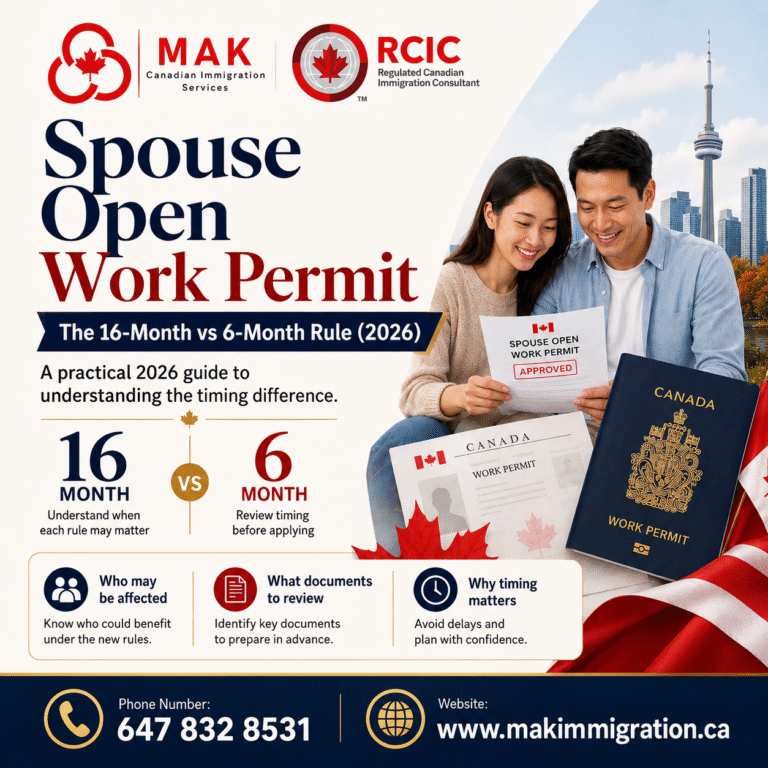
One of the most misunderstood parts of the spousal open work permit is how much validity the principal worker’s permit must have left. Many people assume the answer is always 16 months. It is not. Depending on the route, the rule is 16 months, 6 months, or a completely separate test.
This guide explains, in plain English, when each rule applies in 2026 and why using the wrong eligibility test can lead to refusal. It is general information based on IRCC’s published rules, not case-specific advice. IRCC makes the final decision on every application.
Omer’s July 2026 explainer covers the same 16-month-versus-6-month distinction that Google users are actively searching. The written guide below remains tied to the current IRCC instructions, which were rechecked on September 17, 2026.
Watch: Spousal Open Work Permit 2026 – 16-Month vs 6-Month Rule · Omer Khalil, RCIC profile · Spousal Open Work Permit eligibility and consultation page

CICC Licence R709592 · MAK Canadian Immigration Services
Last reviewed: July 2026
The 16-month rule applies to the ordinary high-skilled-worker measure: the principal worker’s permit must be valid for at least 16 months after IRCC receives the spouse’s application. A separate 6-month rule applies in two situations – where the worker’s permit was issued or approved because of an eligible economic PR application, and where a TEER 4 or 5 worker is on an eligible pathway to permanent residence but has not yet applied. Sponsored spouses and special BC and Quebec measures use their own tests. Which rule applies depends on the worker’s exact situation, not on a single default.
Before you compare the two validity rules, confirm which stream you actually fall under in our main spousal open work permit guide.
The two rules at a glance
| Route | Validity rule | Applies when |
|---|---|---|
| Ordinary high-skilled worker | At least 16 months | Worker in TEER 0 or 1, or a selected TEER 2 or 3 occupation, not relying on a PR-related measure |
| Economic-PR family measure | At least 6 months | Worker’s permit issued or approved because of an eligible economic PR application |
| PR-pathway measure (TEER 4 or 5) | At least 6 months | TEER 4 or 5 worker on an eligible pathway to PR who has not yet applied for PR |
| BC Significant Investment Project | 16-month rule waived | Worker under a qualifying BC SIP agreement (any TEER level) |
| Quebec health-professional project | 16-month rule waived | Worker recruited through a specified Quebec project in NOC 31301, 32103 or 32120 |
The 16-month rule
This is the default for the ordinary high-skilled-worker route, where the principal worker is in a TEER 0 or TEER 1 occupation, or a selected TEER 2 or TEER 3 occupation, and is not relying on one of IRCC’s permanent-residence-related measures. The worker’s permit or authorization to work must remain valid for at least 16 months after the date IRCC receives the spouse or common-law partner’s open work permit application.
The key point is that IRCC counts forward from the date it receives the spouse’s application. It is not enough that the worker’s permit was originally longer than 16 months – what matters is the time remaining when the spouse applies. If the worker has less than 16 months left, the usual fix is to extend the worker’s permit first, then apply for the spouse.
The 6-month rule
The ordinary 16-month rule does not govern every worker’s spouse. Two separate measures use a 6-month validity requirement.
1. Worker connected to an eligible economic PR program
Where the principal worker’s permit was issued or approved because of an eligible economic permanent-residence application, a family member may qualify where the worker has at least six months of permit validity remaining after IRCC receives the family member’s application, and the other conditions are met. A PR application on its own is not enough – the work permit must have the connection to the qualifying PR application that IRCC describes, and the live list of eligible programs and pilots controls.
2. TEER 4 or 5 worker on a pathway to PR
A worker in a lower-skilled TEER 4 or TEER 5 occupation, who is on an eligible pathway to permanent residence but has not yet applied for PR, may support an eligible family member under a separate measure. This route also uses a 6-month remaining-validity requirement and requires the named pathway plus every other listed condition. It does not make every TEER 4 or 5 worker eligible.
Which rule applies to you?
Start with the principal worker’s exact situation, not with the permit dates. Ask: is the worker in a high-skilled occupation and not relying on a PR measure (16 months), was the permit issued because of an economic PR application (6 months), or is the worker a TEER 4 or 5 worker on a PR pathway (6 months)? Sponsored spouses and the BC and Quebec special measures are assessed under their own tests. For the full set of routes, see our 2026 guide to who qualifies for a spousal open work permit.
Common mistakes
The errors we see most often on this point are assuming the 16-month rule applies to everyone; counting from when the worker’s permit was issued rather than from when IRCC receives the spouse’s application; filing as an ordinary high-skilled worker’s spouse when the family’s real route is the economic-PR or pathway measure; and applying when the worker has too little validity left instead of extending the worker’s permit first. These are legal and evidence risks from the current instructions, not a ranking of refusal frequency.
Not sure which rule applies to your family? Book a paid consultation with a licensed RCIC, or start with MAK’s Free Immigration Scanner.
Frequently asked questions
Is the spousal open work permit rule always 16 months?
No. The 16-month rule is only for the ordinary high-skilled-worker measure. A 6-month rule applies to the economic-PR family measure and to the TEER 4 or 5 PR-pathway measure, and other routes use their own tests.
When does IRCC start counting the validity period?
From the date IRCC receives the spouse or common-law partner’s open work permit application, not from when the worker’s permit was issued.
My permit has less than 16 months left. What can I do?
Under the high-skilled measure, the usual step is to extend the principal worker’s permit first, then apply for the spouse. Confirm your exact route before assuming the 16-month rule even applies.
Do the BC and Quebec 2026 measures use these rules?
No. The BC Significant Investment Project measure and the specified Quebec health-professional measure waive the 16-month requirement for those who qualify.
Official sources reviewed
- IRCC – Open work permits for family members of foreign workers: Who can apply
- IRCC – Changes to open work permits for family members of temporary residents
Official IRCC sources rechecked: September 17, 2026.
This page provides general Canadian immigration information and is not case-specific legal advice. Rules, occupation lists and public policies can change. IRCC makes the final decision on every application.
Permit validity is not the same as processing time. For current IRCC estimates and how to check them yourself, read our Canada work permit processing time guide.

