
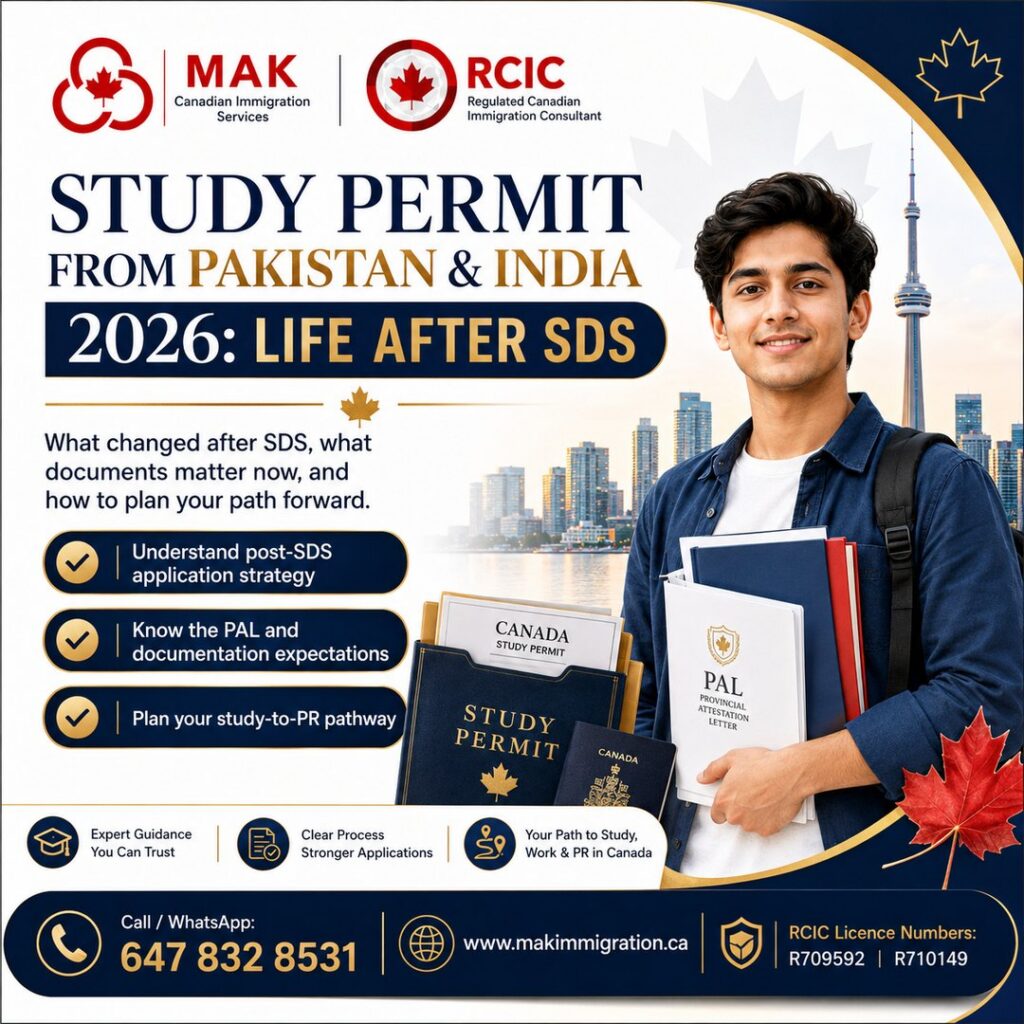
Canada Study Permit from Pakistan in 2026: What Replaced SDS?
If you are applying for a Canadian study permit from Pakistan in 2026, the process is not what it was two years ago. The fast-track Student Direct Stream (SDS) is gone, the proof-of-funds figure is higher, and most applicants now need a Provincial Attestation Letter. This guide explains, in plain English, how the regular study permit stream works now for Pakistani students, what evidence to prepare, and the weaknesses that lead to refusals.
It is based on IRCC’s own published rules and figures, checked on July 16, 2026. Amounts and rules change and IRCC makes all final decisions, so confirm the current requirements on the official pages before you apply.
Table of Contents
- Quick Answer
- SDS ended: what Pakistani applicants do now
- What did and did not change after SDS
- 2026 proof-of-funds figures
- Do I need a PAL? Decision guide
- Regular-stream application steps
- Pakistan source-of-funds framework
- Common study-permit weaknesses to address
- PGWP eligibility: read before you enrol
- Three worked examples
- What to do next
- Frequently Asked Questions
- Official Sources Reviewed
Quick Answer
The Student Direct Stream (SDS), the fast-track that once served Pakistan, ended on November 8, 2024. Applicants who would previously have used SDS now apply through the regular study permit process. For 2026 that generally means a letter of acceptance from a designated learning institution (DLI), a Provincial or Territorial Attestation Letter in most cases, and proof that you have enough money for tuition, travel, and living costs – with living costs alone set at CAD $22,895 for a single applicant outside Quebec for applications filed on or after September 1, 2025. A GIC is still an accepted way to show part of your funds but is not mandatory and does not guarantee approval. There is no longer a guaranteed country-based fast-track processing time.
Planning a study permit from Pakistan and want it done right the first time? Book a consultation with MAK Canadian Immigration Services. Your immigration advice will be provided by a licensed RCIC regulated by the CICC. You can also start with our free immigration scanner. IRCC makes all final decisions.
SDS ended: what Pakistani applicants do now
The Student Direct Stream launched in 2018 to give faster study permit processing to students from a set list of countries, including Pakistan (Nigeria had a similar process called the Nigeria Student Express). On November 8, 2024, at 2:00 p.m. ET, IRCC ended both. Applications received before that moment were processed under the old streams; every application submitted on or after that time is processed under the regular study permit stream. IRCC’s stated reason was to give all international students equal and fair access regardless of country of origin, strengthen program integrity, and reduce student vulnerability. Other exemptions or special initiatives may still apply to particular applicants, but the SDS fast-track for Pakistan is no longer available.
What did and did not change after SDS
| Item | Under SDS (before Nov 8, 2024) | Regular stream (now) |
|---|---|---|
| Application stream | SDS fast-track for eligible countries | One regular study permit stream for everyone |
| GIC | Effectively required for SDS | Accepted as proof of funds, but not mandatory |
| PAL / TAL | Not part of SDS originally | Required for most applicants (some exemptions) |
| Proof of funds | GIC plus first-year tuition | Living-cost figure ($22,895 single, outside Quebec) plus tuition and travel |
| Processing | Faster, country-based service standard | No guaranteed country-based fast-track |
| Approval | Never guaranteed | Never guaranteed |
2026 proof-of-funds figures
For study permit applications filed on or after September 1, 2025 (outside Quebec), you must show that you can cover your first year of living costs, on top of tuition and travel. These are living costs only:
| People (including you) | Funds required for one year (living costs, outside Quebec) |
|---|---|
| 1 (just you) | CAD $22,895 |
| 2 | CAD $28,502 |
| 3 | CAD $35,040 |
| 4 | CAD $42,543 |
| 5 | CAD $48,252 |
| 6 | CAD $54,420 |
| 7 | CAD $60,589 |
| Each additional person | add CAD $6,170 |
Important: tuition is additional, transportation is additional, and you must show enough for your first year. If your program is longer than one year, be ready to explain how you will finance the full program. Quebec sets its own amounts, and IRCC updates these figures, so re-check the official financial-support page before you file.
Do I need a PAL? Decision guide
Because of the international student cap, most study permit applicants must include a valid Provincial Attestation Letter (PAL) or Territorial Attestation Letter (TAL) from the province where they will study, or IRCC will return the application. Some applicants are exempt.
| Your situation | PAL / TAL needed? |
|---|---|
| Most new college or bachelor’s applicants | Yes – include a valid PAL/TAL |
| Master’s or doctoral student at a public DLI (from January 1, 2026) | Generally exempt |
| Certain other exempt groups (for example some exchange or in-Canada situations) | Check the official PAL page |
Confirm your exact category on IRCC’s PAL/TAL page and with your school before you apply, because the exemptions are specific. See our Canada Study Permit 2026 guide for the cap and PAL details.
Regular-stream application steps
You apply online, pay the fees, give biometrics, and submit your documents. An officer assesses whether you meet the requirements and whether you are a genuine student who will leave Canada at the end of your authorized stay. Processing time depends on your application, the visa office, document completeness, biometrics, and any medical or security checks, rather than a fixed country-based service standard – so check current IRCC processing times for an estimate.
Pakistan source-of-funds framework
For applicants from Pakistan, how you show your money often matters as much as the amount. Officers look for funds that are genuinely available and clearly explained. None of these guarantee approval, but documentary consistency and a clear paper trail help:
| Source | Evidence that helps show it is genuine |
|---|---|
| Salaried parent or sponsor | Salary slips, employment letter, bank statements showing regular salary credits |
| Self-employed sponsor | Business registration, tax records, bank statements, a clear picture of income over time |
| Education loan | Sanction letter from the bank, terms, and confirmation the funds are available |
| Recent property sale | Sale deed, proof the funds reached the account, explanation of the source of the property |
| Scholarship | Official award letter stating the amount and what it covers |
| Applicant’s own savings | Statements showing how the savings were built up over time, not a sudden deposit |
Avoid large, unexplained, recently-deposited lump sums – they raise questions about whether the money is truly available and where it came from.
Common study-permit weaknesses to address
Refusals usually come down to a small number of legal concepts an officer must be satisfied on. Strengthen each one:
- Acceptance at a DLI – a genuine letter of acceptance from a designated learning institution.
- Financial sufficiency – funds that clearly cover tuition, travel, and living costs, and are genuinely available.
- Credible purpose of study – a study plan that makes sense for your background and goals.
- Document consistency – names, dates, and figures that match across every document.
- Admissibility – meeting health, security, and other admissibility requirements.
- Leaving at the end of your stay – the officer must be satisfied you will leave Canada at the end of the period authorized.
PGWP eligibility: read before you enrol
A post-graduation work permit (PGWP) is often the bridge from study to work to PR, but graduating from a DLI does not automatically make you PGWP-eligible. In general, most PGWP applicants now need to meet a language requirement, subject to official exemptions. Field-of-study requirements apply in certain cases, particularly for some non-degree programs, and depend on the relevant study-permit or application dates. Before you enrol, verify your program against IRCC’s official DLI list and PGWP eligibility tools so you do not choose a program that will not lead to a PGWP.
Three worked examples
These are simplified, hypothetical examples to show how the pieces fit together. They are not legal determinations, and every real case is assessed on its own facts.
What to do next
Prepare your acceptance and PAL, build a clean and well-sourced funds file, and write a study plan that answers the officer’s likely questions before they ask. MAK Canadian Immigration Services can review your profile, flag weaknesses before you file, and help you present a complete, consistent application. As a licensed RCIC firm regulated by the CICC, we give you a straight assessment. IRCC makes the final decision.
Want your Pakistan study permit file reviewed before you submit? Book a consultation with MAK, in person at our Mississauga office or online, or start with our free immigration scanner. You can also review our professional fees. IRCC makes all final decisions.
Frequently Asked Questions
Is the SDS still available for Pakistan in 2026?
No. The Student Direct Stream ended on November 8, 2024. Applicants who would have used SDS now apply through the regular study permit stream.
How much money do I need for a study permit from Pakistan in 2026?
For applications filed on or after September 1, 2025 (outside Quebec), living costs alone are CAD $22,895 for a single applicant, on top of tuition and travel. Larger family sizes need more, and Quebec sets its own amounts.
Do I still need a GIC?
A GIC is an accepted way to show part of your funds, but it is not mandatory and does not by itself guarantee approval.
Do I need a Provincial Attestation Letter (PAL)?
Most applicants do. Master’s and doctoral students at a public DLI are generally exempt from January 1, 2026, along with some other groups. Confirm your category on IRCC’s PAL page.
Is processing faster from Pakistan now?
No. There is no guaranteed country-based fast-track since SDS ended. Processing depends on your application, the visa office, and any additional checks.
Official Sources Reviewed
This article was reviewed against current official Government of Canada and IRCC sources. Official sources last checked: July 16, 2026.
- IRCC – End of the Student Direct Stream and Nigeria Student Express
- IRCC – Proof of financial support
- IRCC – Provincial/Territorial Attestation Letter
- IRCC – Post-graduation work permit eligibility
- IRCC – Study permit (main page)

