
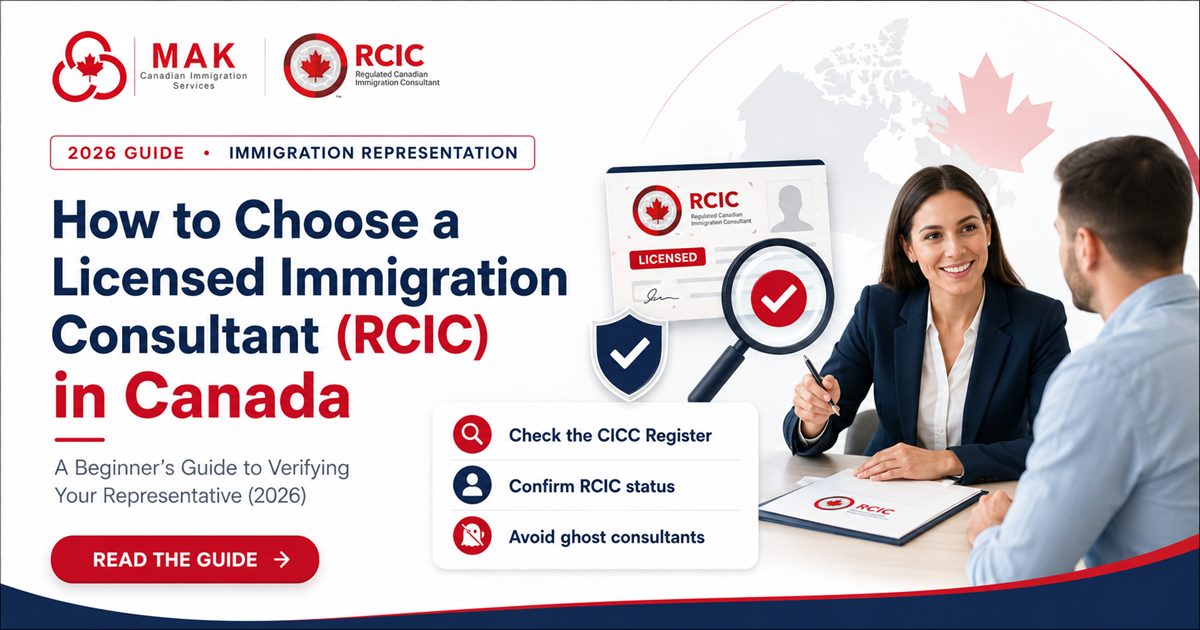
A genuine Canadian immigration representative should be independently verifiable. This guide explains how to check an RCIC on the College’s public register, compare the name and licence number with the person you are dealing with, and look for basic professional safeguards such as a written service agreement, clear fees and accountable communication.
If you are new to Canadian immigration, one of the first — and most important — decisions you will make is who helps you. Get it right and you have a trained, accountable professional in your corner. Get it wrong and you can lose your money, lose your application, and in the worst cases lose your ability to come to or stay in Canada. This guide is written for applicants with zero immigration background. It explains who is actually allowed to represent you, what can go wrong with an unlicensed “ghost consultant,” how to verify a consultant in about two minutes, and what “in good standing” really means — so you can hire with confidence.

Table of Contents
- Detailed Answer
- Who Can Legally Give Canadian Immigration Advice?
- What Can Go Wrong: Consequences of Using an Unlicensed Consultant
- How a Licensed Consultant Protects You
- How to Verify a Consultant: Step by Step
- What Does “In Good Standing” Actually Mean?
- RCIC or Lawyer — Which Do You Need?
- Red Flags: Warning Signs to Walk Away From
- The Use of a Representative Form (IMM 5476)
- Questions to Ask Before You Hire
- If You Have Already Been Scammed
- What to Do Next — and How MAK Can Help
- Frequently Asked Questions
- Sources Reviewed
Detailed Answer
In Canada, only three types of professionals may legally represent or advise you for a fee: Regulated Canadian Immigration Consultants (RCICs) licensed by the College of Immigration and Citizenship Consultants (CICC), lawyers and paralegals who are members in good standing of a provincial or territorial law society, and notaries of the Chambre des notaires du Québec. Anyone else who charges you is an unauthorized “ghost consultant,” and using one can cost you your money and your application — and even trigger a five-year ban from Canada for misrepresentation. Before you pay anyone, get their licence number and confirm on the CICC public register that they are active and in good standing. No honest representative can guarantee your approval.
Not sure whether a consultant is genuinely licensed? Book a consultation with MAK Canadian Immigration Services. You will deal directly with a licensed RCIC regulated by the CICC — meet our team. You can also run the Free Immigration Scanner first. No immigration outcome can be guaranteed, and final decisions are made by the government.
Who Can Legally Give Canadian Immigration Advice?
This is the single most important thing to understand before you pay anyone. Under section 91 of the Immigration and Refugee Protection Act (IRPA), it is against the law for anyone to represent or advise you for a fee — or any other consideration — in connection with a Canadian immigration application, unless they are an authorized representative. Immigration, Refugees and Citizenship Canada (IRCC) recognizes only three categories of paid, authorized representatives:
- Immigration consultants who are members in good standing of the College of Immigration and Citizenship Consultants (CICC) — known as Regulated Canadian Immigration Consultants (RCICs).
- Lawyers and paralegals who are members in good standing of a Canadian provincial or territorial law society.
- Notaries who are members in good standing of the Chambre des notaires du Québec.
Anyone outside these three groups who charges you is operating illegally. IRCC calls them unauthorized representatives; the public knows them as “ghost consultants.” You are also never required to hire anyone — IRCC treats every application the same whether or not you use a representative, and no representative can get your file “special treatment.”
What Can Go Wrong: Consequences of Using an Unlicensed Consultant
Using a ghost consultant is not a small risk, and here is the part many applicants do not realize: some of the worst consequences fall on you, not on the person you paid.
You can be refused and lose your money
Unauthorized representatives often complete forms incorrectly, miss deadlines, or give wrong advice. If your application is refused, you lose the government fees, the fee you paid the consultant, and valuable time — and because the person is not regulated, you usually have no way to recover your money.
You can be banned for misrepresentation — even if you did not know
This is the most serious danger. Under section 40 of the IRPA, you can be found inadmissible for misrepresentation if false or misleading information or documents are submitted in your case — and the law applies even when someone else, such as a consultant or agent, does it on your behalf. Misrepresentation does not require that you intended to lie; even an error you did not catch can trigger it. The consequences are severe: your application is refused, you can be barred from applying to or entering Canada for five years, and a permanent record of misrepresentation is placed on your IRCC file. If you already hold status in Canada, you can lose it and be removed. A ghost consultant who quietly inflates your work experience or slips in a fake document is gambling with your future, not theirs.
You have no one to complain to
When you hire a licensed RCIC or lawyer and something goes wrong, you can file a complaint with their regulator — the CICC or the law society — which can investigate and discipline them. With a ghost consultant there is no regulator, no insurance, and often no way to find the person again once they have your money. IRCC and the Canada Border Services Agency do investigate and prosecute unauthorized consultants, but that does not undo the damage already done to your file.
How a Licensed Consultant Protects You
A Regulated Canadian Immigration Consultant is not simply someone who passed an exam once. To hold and keep a licence, an RCIC must meet ongoing requirements set by the College of Immigration and Citizenship Consultants: entry-to-practice education and examinations, a binding professional code of conduct, mandatory errors and omissions (E&O) insurance, continuing professional development every year, and accountability to a formal complaints and discipline process. In plain terms, hiring a licensed RCIC protects you in ways a ghost consultant never can — they are trained, insured, accountable, and on the public record. If they ever act improperly, you have a real path to recourse.
How to Verify a Consultant: Step by Step
You do not need any immigration knowledge to check whether someone is licensed. It takes about two minutes:
- Ask for their full name and licence number. An RCIC licence number is the letter R followed by six digits (for example, R709592).
- Open the CICC Public Register at register.college-ic.ca and search by the person’s name or licence number.
- Confirm it is the right person — check the name, photo, and firm shown on the register against who you are actually dealing with.
- Check the licence class. An RCIC can represent you on immigration applications. A RISIA (Regulated International Student Immigration Advisor) is limited to advising international students on study-related matters and cannot represent you on a full immigration application. Make sure the class matches what you need.
- Confirm the status is “Active” and “In Good Standing.” Only a licensee who is active and in good standing is authorized to practise (the next section explains exactly what this means).
- Check for disciplinary history. The register shows whether the licensee has been subject to disciplinary action; if there is any, read it.
Write down the licence number and keep a screenshot of the register entry for your records. If the person is not on the register, is not active, or refuses to give a number, do not hire them. For a lawyer, verify membership through the relevant provincial or territorial law society instead.
What Does “In Good Standing” Actually Mean?
You will see the phrase “in good standing” on the register, and it matters more than most people realize. “In good standing” means the licensee is currently meeting all of the College’s requirements and is authorized to use their designation and practise. A consultant in good standing has paid their annual dues, carries current mandatory errors and omissions (E&O) insurance, has completed their required continuing professional development, and is not under an active disciplinary suspension. Importantly, a licensee who is not in good standing is not even permitted to use the “RCIC” title.
Here is how to read the statuses you may see on the register:
- Active & In Good Standing — authorized to practise. This is what you want to see.
- Inactive or On Leave of Absence — the person holds a licence but is not currently practising, and should not be taking on your file right now.
- Suspended, Revoked, Cancelled, or Surrendered — their authorization has been removed or given up. Do not hire them.
- Disciplinary actions listed — the College has taken action against them at some point. Read the details and weigh them carefully.
One more distinction worth knowing: some RCICs hold a higher licence class that additionally authorizes them to represent clients before the Immigration and Refugee Board (IRB) in hearings and appeals. For an ordinary application, though, what matters most is simple — an RCIC who is Active and In Good Standing.
RCIC or Lawyer — Which Do You Need?
Both RCICs and immigration lawyers are authorized, and both can represent you before IRCC. The right choice depends on your situation:
- A Regulated Canadian Immigration Consultant (RCIC) specializes specifically in immigration — Express Entry (including Canadian Experience Class), spousal and family sponsorship, work and study permits, visitor and super visas, and business immigration. An RCIC can provide regulated professional advice and representation on Canadian immigration matters within the scope of the retainer.
- An immigration lawyer may be the better fit if your matter involves litigation, a Federal Court appeal, a judicial review, or a complex legal dispute.
What matters most is not the title but two things: a valid, active licence, and genuine experience with cases like yours. Relevant experience with the type of application is one factor to consider when choosing a representative.
Red Flags: Warning Signs to Walk Away From
Immigration fraud follows patterns. Be very cautious of anyone who:
- Guarantees a visa, PR, or a specific outcome. No honest professional can — IRCC states plainly that no one can guarantee approval. If it sounds too good to be true, it is.
- Offers to sell you a job offer or LMIA, or suggests putting false information or fake documents on your application.
- Will not provide a written retainer or service agreement setting out the services and fees.
- Refuses to be named on your application as your representative, or asks to log into your account and submit as though you applied on your own.
- Writes on the form that they are an “unpaid” representative and then charges you — IRCC specifically warns about this trick.
- Wants large cash payments with no receipts.
- Is not on the CICC register, or dodges the question when you ask for a licence number.
The Use of a Representative Form (IMM 5476)
Here is a simple test that exposes most ghost consultants. When you hire a paid representative, IRCC requires that person to be officially declared on your application using form IMM 5476 (Use of a Representative). A genuine RCIC will complete and sign this form and go on record with IRCC and the Canada Border Services Agency as your authorized representative.
An unauthorized operator, by contrast, wants to stay invisible. If a “consultant” takes your money but refuses to be named on your file — or insists on logging into your account and submitting as though you did everything yourself — that is a serious warning sign. Insist that any paid representative you hire appears on your IMM 5476. If they will not, they are not someone to trust with your future.
Questions to Ask Before You Hire
A few direct questions will quickly separate a professional from a risk:
- What is your RCIC licence number? (Then verify it yourself on the CICC register.)
- Are you currently active and in good standing with the CICC?
- Will I receive a written agreement listing the exact services and fees?
- Will you be named as my representative on form IMM 5476?
- Who specifically will handle my file — you, or someone else?
- What are the realistic risks and timelines for my situation?
- Will you tell me honestly if I am not eligible, even if it is not what I want to hear?
If You Have Already Been Scammed
If you think you have dealt with an unauthorized consultant, act quickly. You can report immigration fraud to IRCC and the CBSA, and if a licensed consultant or lawyer behaved improperly you can file a complaint against a representative with the CICC or the relevant law society. Most importantly, if false information may have been submitted in your case, speak to a licensed professional as soon as possible — how and when you correct the record can affect whether you face a misrepresentation finding.
What to Do Next — and How MAK Can Help
Before you hire anyone, do the two-minute check: get the licence number and confirm on the CICC Public Register that the person is active and in good standing. Ask for a written agreement, and make sure your representative will be named on your IMM 5476. Those checks can help you verify who you are hiring and clarify the scope of the representation.
MAK Canadian Immigration Services is led by licensed consultants regulated by the College of Immigration and Citizenship Consultants (CICC). Every file is RCIC-led and reviewed by a licensed RCIC, and we welcome clients to verify our consultants — Usman Khalil (R709592) and Omer Khalil (R710149) — on the CICC register before booking. We advise clients in person at our Mississauga office and online across Canada and abroad.
Ready to work with a licensed RCIC you can verify? Book a consultation with MAK Canadian Immigration Services, in person at our Mississauga office or online. You can also run the Free Immigration Scanner. No immigration outcome can be guaranteed, and final decisions are made by the government.
If you are in Pakistan, you can also consult MAK’s licensed RCICs from Lahore. Our DHA client-support office handles document intake and appointment coordination, and your immigration advice remains RCIC-led.
Frequently Asked Questions
How do I check if an immigration consultant is licensed in Canada?
What does “in good standing” mean for an immigration consultant?
What is a ghost consultant, and why is it risky?
What happens if my consultant submits false information?
Is a RISIA the same as an RCIC?
Is an RCIC the same as an immigration lawyer?
Can an immigration consultant guarantee my visa or PR?
Do I have to use a representative to apply?
What is the IMM 5476 form?
Sources Reviewed
This article was checked against the following official sources before publication: IRCC — Using an immigration and citizenship representative; IRCC — How to choose a representative; IRCC — Consequences of immigration and citizenship fraud; IRCC — File a complaint against a representative; IRCC — Use of a Representative form (IMM 5476); the CICC — Find an Immigration Consultant and About RCICs and RISIAs pages and the Public Register; and the Immigration and Refugee Protection Act — section 40 (misrepresentation) and section 91 (representation). Last reviewed: September 2026. Sections 40 and 91 of the Immigration and Refugee Protection Act were re-read on Justice Laws on 9 September 2026 (Act current to 21 June 2026, last amended 26 March 2026): section 91(2) still names exactly three groups who may represent or advise for a fee, and section 40(2)(a) still sets the misrepresentation inadmissibility period at five years. The CICC Public Register at register.college-ic.ca answered on the same day.
Disclaimer: This article is for general information only and is not legal advice. Immigration rules, fees, and processes change; always confirm current requirements on the official Government of Canada website at canada.ca or consult a licensed immigration professional about your specific situation. No outcome can be guaranteed.

