
Working for a Canadian company outside Canada can count toward the 730 days a permanent resident needs, but only when the work abroad is a genuine assignment. The employer must be a qualifying Canadian business, and you must be assigned abroad full-time as a term of your job or contract. The Federal Court also reads the rule as requiring a temporary assignment and a real plan for you to keep working for the employer in Canada afterwards. A Canadian pay stub, on its own, does not prove any of that.
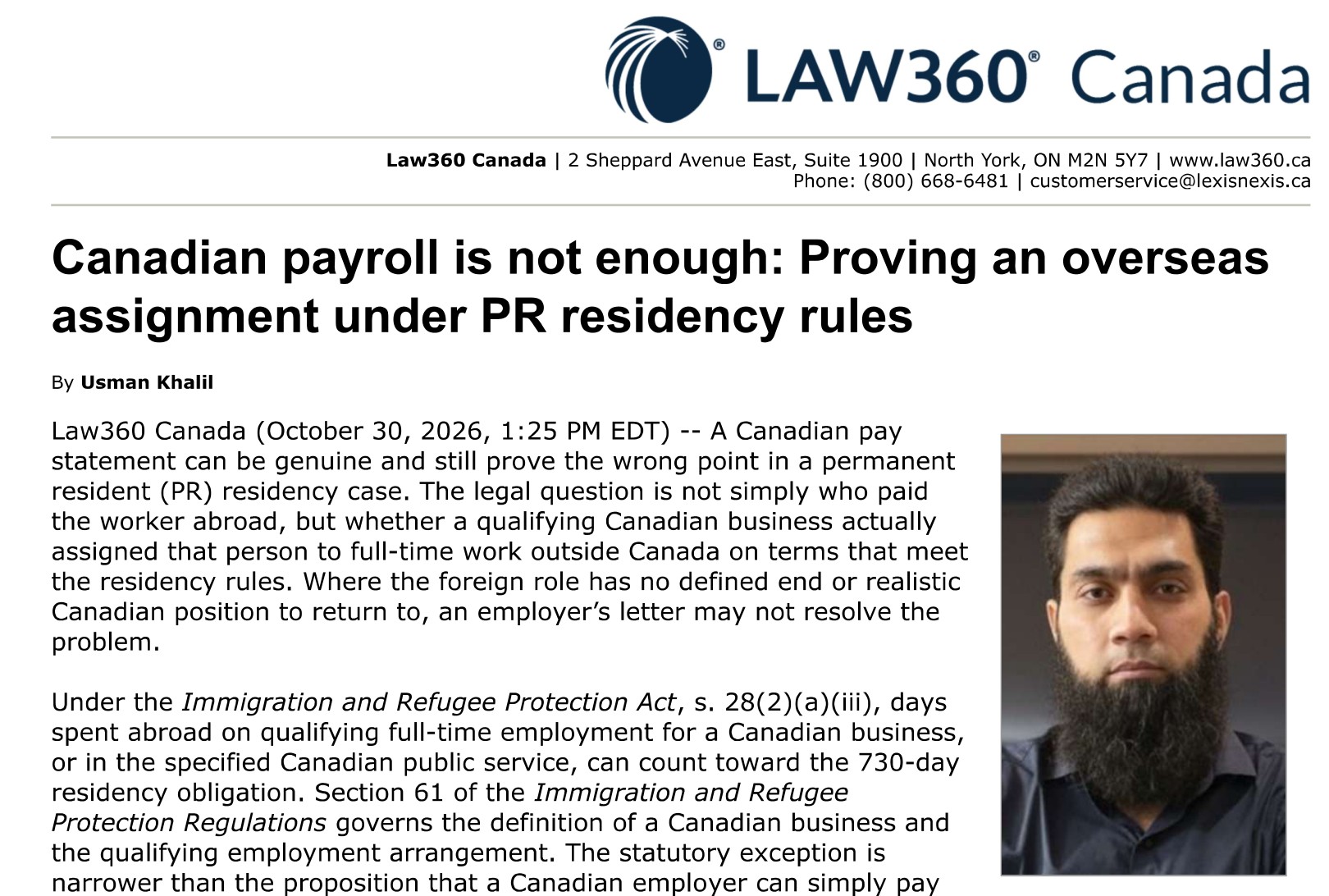
Reviewed by Usman Khalil, RCIC R709592, CPA Ontario C83028834, after a fact check against IRCC, Justice Laws and Federal Court sources on 2 November 2026. Based on his commentary first published in Law360 Canada on 30 October 2026. General information, not individualized immigration advice.
The three tests, in one place:
- The employer: it must be a “Canadian business” under section 61(1) of the Regulations, and not a business that exists mainly to help someone meet the residency obligation from abroad (section 61(2)).
- The arrangement: you must be assigned full-time, as a term of your job or contract, to a position, an affiliated enterprise or a client outside Canada (section 61(3)).
- The assignment: the Federal Court reads “assigned” as a temporary posting with a return to the employer in Canada. IRCC’s Guide 5445 asks for the return part: that “you will continue working for the employer in Canada after the assignment.”
Can days working abroad for a Canadian company count toward the 730 days?
They can, but only if the job passes a strict legal test. Section 28(2)(a)(iii) of the Immigration and Refugee Protection Act counts days spent “outside Canada employed on a full-time basis by a Canadian business”, but section 61 of the Regulations and the Federal Court add conditions: you must be assigned abroad as a term of your job, temporarily, with evidence that the employer is firmly committed to bringing you back to a position in Canada.
The same provision also covers people employed abroad “in the federal public administration or the public service of a province.” Section 61 defines what a “Canadian business” is (section 61(1)) and what this kind of full-time employment abroad means (section 61(3)).
Section 28(1) says a permanent resident must meet the residency obligation “with respect to every five-year period.” The 730 days are a total. Days you are physically present in Canada and qualifying days abroad can be added together, because section 28(2)(a) lists both as ways to count a day.
IRCC’s own guide says it “is not a legal document” and that the legal text prevails if the two differ. That is why this post starts with the Act and the Regulations, then shows what IRCC asks for as evidence.
What counts as a “Canadian business” for this rule?
Section 61(1) of the Regulations gives three options: a federally or provincially incorporated corporation “that has an ongoing operation in Canada”; another enterprise with an ongoing operation in Canada that can generate revenue, is carried on in anticipation of profit and is majority-held by Canadian citizens, permanent residents or Canadian businesses; or “an organization or enterprise created under the laws of Canada or a province.” Section 61(2) then excludes any business “that serves primarily to allow a permanent resident to comply with their residency obligation while residing outside Canada.”
For a corporation, section 61(1)(a) asks two separate things: was it incorporated in Canada, and does it have an ongoing operation here? Incorporation papers answer the first question only. For the second, Guide 5445’s optional list points to records of a working business, such as corporate tax notices of assessment, financial statements and annual reports.
Work out which of the three options fits your employer before you gather papers. A non-corporate enterprise, for example, must also meet ownership and profit conditions that do not apply to a corporation.
Is being on a Canadian payroll enough?
No. Section 61(3) requires that you are “assigned on a full-time basis as a term of the employment or contract” to a position, an affiliated enterprise or a client outside Canada, and the Federal Court reads “assigned” as a temporary posting with a return to the employer in Canada. Payroll shows who paid you; it does not show that the posting was temporary or that a Canadian role is waiting for you.
The words “temporary” and “return” do not appear in section 61(3). They come from case law. In Canada (Citizenship and Immigration) v. Luo, 2020 FC 543, the court said at paragraph 24 that “assigned” needs two things: full-time work outside Canada on a temporary basis, and continued work for the employer in Canada once the assignment ends. At paragraph 25 the court accepted that the second element “is admittedly not apparent upon a plain reading of the provision”, but said the court had applied it consistently.
Luo also shows how much evidence is needed. Paragraph 28 says there must be more than a mere “possibility” or “some assurances” of reintegration. Paragraph 29 calls evidence of the employer’s intention to continue employing the person on return “a key element.”
In Ghaith v. Canada (Citizenship and Immigration), 2025 FC 739, the court held that the appeal tribunal was bound to follow this line of cases and had applied it reasonably (paragraphs 15, 17 and 21). At paragraph 16, it quotes Da v Canada, 2024 FC 1952 at paragraph 17: “assigned” refers to “a discrete period during which a permanent resident is temporarily based abroad”, with “evidence pointing to a firm commitment on the part of the employer to reintegrate the employee within a specified timeframe to a position in Canada.”
The applicant in Ghaith argued that the case law reads too much into the regulation. The court did not decide that point, because it had not been raised before the tribunal, and it refused to send it to the Federal Court of Appeal (paragraphs 19, 28 and 29).
IRCC’s guidance reflects the return part of the test. Situation A in Guide 5445, Appendix A counts days worked abroad only if, among other things, “you will continue working for the employer in Canada after the assignment.” The guide does not use the word “temporary”; that part comes from the courts.
This is the core of Usman Khalil’s commentary in Law360 Canada, 30 October 2026: a pay record can be completely genuine and still leave the assignment question unanswered. You can read more of Usman’s published analysis on our media page.
What Usman Khalil sees in these files
What clients usually bring. “Most clients come to me with Canadian pay stubs, T4s, or a letter from their employer. I explain that being paid in Canada doesn’t automatically mean their time abroad counts toward PR residency. IRCC needs evidence of a genuine temporary assignment and a real position to return to in Canada.”
The situation behind most of these files. “A common situation is someone being transferred overseas to work for a foreign affiliate or client while remaining on Canadian payroll. What starts as a temporary assignment gets extended, sometimes for years, without a clear return date or position in Canada. That’s where residency problems begin.”
Usman Khalil, RCIC, describing his own client files. Individual situations differ.
What if it is my own company or a family company?
Nothing in section 61 excludes a company just because you or a relative own it, but section 61(2) excludes a business that serves primarily to let a permanent resident meet the obligation while living abroad, and the assignment test still applies in full. Guide 5445 also asks the business official’s letter to confirm “that the business was not created mainly for the purpose of meeting your residency obligation.”
Two Federal Court cases involved family links. In Ghaith, the employer was a Canadian company partly owned by the applicant’s father (paragraph 2). The court found no error where there was no set end date for the assignment and the evidence said he might return only “if and when” projects needed him (paragraph 17).
In Luo, the Ontario employer was owned by the couple’s former son-in-law (paragraph 6). The offer of employment listed no termination date, and the contract did not say he would return to a position with the company in Canada (paragraph 7). The court set aside the tribunal’s favourable decision and sent the matter back for a new decision.
Neither decision turned on who owned the company. Both turned on the missing evidence of a return plan, and Ghaith also on the missing end date. Ghaith says at paragraph 16 that there was “no question” the employer was a Canadian company; the only issue was whether he was “assigned.”
What must the employer’s letter say?
For anyone relying on Situation A, Guide 5445 asks for “a letter signed by an official of the business” that confirms the five points listed below. Officers read that letter alongside the contracts and records behind it, so the details need to match.
- The position and title of the person signing.
- The nature of the business and how it fits the Canadian-business definition.
- The details of your assignment or contract abroad, such as its length, confirmation that the full-time work abroad is a term of your job or contract, and a description or copy of the position profile.
- That you will continue working for the employer in Canada after the assignment ends.
- That the business was not created mainly for the purpose of meeting your residency obligation.
A promise in a letter does not fill a gap in the record. In Luo, the employer’s letter and testimony spoke well of the employee, yet nothing on file showed a plan to bring him back into the Canadian operation (paragraphs 23, 27 and 29). The court also noted it was not apparent his work would be needed in Canada, given what he did abroad (paragraph 27). If the Canadian role you would return to differs from your work abroad, the letter should name that role and say why the business needs it.
What other records help prove the assignment?
Guide 5445 lists optional records: articles of incorporation and business licences, partnership agreements or annual reports, corporate tax notices of assessment or financial statements, the employee assignment agreement or contract, agreements with the foreign client or affiliate, pay statements, personal notices of assessment for the five years before the application, T4 slips and any other proof. No single record covers all three tests, so check them against each other: the dates, job title and employer name should match across the letter, the agreement and the pay records.
The guide says that if you spent fewer than 1,095 days outside Canada, the supporting documents are not mandatory, but leaving them out “may impact the assessment” of your residency obligation. If you were outside Canada for more than 1,095 days, the guide says you may count Situation A days toward the obligation, which is when this evidence matters most.
| Record | What it can help show | What it does not show on its own |
|---|---|---|
| Signed letter from a business official (asked for by Guide 5445 for Situation A) | The employer’s account of the business, your assignment, the return to a Canadian role and why the business exists. | It does not replace the underlying contracts, and it should match them. |
| Employee assignment agreement or contract | That the posting abroad is a term of the job, full-time, for a set period, with a defined return. | Whether the business itself qualifies as a Canadian business. |
| Agreements with the foreign affiliate or client | That you were placed with an affiliate or client of the Canadian business, and on what terms. | Your personal return arrangement in Canada. |
| Articles of incorporation, business licences | That the business was formed or licensed. | That it has an ongoing operation in Canada. |
| Corporate tax assessments, financial statements, annual reports | That the business is active. | The terms of your assignment. |
| Pay statements, T4 slips, personal notices of assessment | That the Canadian employer paid you. | That the posting was temporary or that a Canadian position is waiting (the test in Luo and Ghaith). |
The table is MAK’s reading of how the records fit together. An officer weighs the whole file.
How do I report assignment days on the PR card form?
On IMM 5444, answer question 5.2 about full-time employment abroad by a Canadian business, then list every absence in question 5.5 from the most recent to the oldest, using reason “A” only for qualifying assignment days. If only part of a trip was a qualifying assignment, IRCC’s instructions say to show that absence “as two separate lines in the table.”
IMM 5444 is the same form for a PR card and a permanent resident travel document. Its instructions say the day you leave and the day you return count as days in Canada, so they are excluded from the days you were absent. A trip where you leave and come back on the same day does not need to be listed.
Long absences often contain more than one arrangement: a first contract, an extension, a move to another country or a new employer. Treat each one as its own period on the table, and give reason “A” only to the stretches your documents support. For the full form, see our Appendix A and IMM 5444 Section 5 walkthrough.
Does it matter whether I have been a PR for less or more than five years?
Yes. Under section 28(2)(b), if you have been a permanent resident for less than five years, you need to show that you “will be able to meet” the obligation in the five years after you became a PR; at five years or more, you need to show that you “have met” it in the five years immediately before the examination.
For a newer permanent resident, the question looks forward: can 730 qualifying days still be reached inside the first five years? Any assignment days you claim must fall inside that window. An earlier approval does not settle a later period either. In Ghaith, an officer had accepted the employment ground when issuing a PR card in 2014, but that did not decide the later case, because compliance is assessed for each five-year period (paragraphs 3, 22, 24 and 25).
What about a spouse or children who come with me?
A permanent resident who is outside Canada accompanying a PR spouse, common-law partner or parent employed this way can also count those days, under section 28(2)(a)(iv). Section 61(5) of the Regulations says the accompanying person complies “as long as the permanent resident they are accompanying complies”, so the family’s days depend on the employee’s assignment meeting the test.
“Accompanying” means ordinarily residing with that person (section 61(4)). For this rule, a child is under 22 and not a spouse or common-law partner (section 61(6)). Accompanying a Canadian citizen spouse or parent is a different rule, under section 28(2)(a)(ii), and our Appendix A walkthrough covers it.
How long can a permanent resident stay outside Canada?
Section 28 does not set a limit per trip; it requires at least 730 qualifying days in total in each five-year period. IMM 5444 adds that if your time outside Canada, not counting qualifying A, B or C days, reaches 1,095 days or more, “you may not meet the residency requirements.”
For the basic count, see how the 730 days are counted for a PR card renewal. Days working abroad for a Canadian business help only with keeping PR status. For citizenship, section 5(1)(c) of the Citizenship Act requires at least 1,095 days of physical presence in Canada. Section 5(1.02) makes an exception for permanent residents employed abroad in or with the Canadian Armed Forces, the federal public administration or a provincial public service, other than as locally engaged staff, and section 5(1.03) extends it to a spouse, partner or child living with them. Read the 1,095-day citizenship count before relying on time abroad for citizenship.
What if the assignment does not qualify?
Days that fail the test are ordinary time outside Canada and are listed with the reason “Other” on IMM 5444. If that leaves you short, section 28(2)(c) allows an officer to decide that humanitarian and compassionate considerations, including the best interests of a directly affected child, justify keeping PR status, and that decision overcomes the breach.
Keep the two arguments apart. Hardship does not prove an assignment, and an assignment claim should stand on its own documents. In Ghaith, the tribunal assessed the humanitarian request on its own, and the court found that analysis reasonable (paragraphs 22 to 26).
Guide 5445 says a humanitarian request must show “exceptional circumstances or factors beyond your control” that kept you outside Canada. You answer question 5.7 on IMM 5444, explain why you could not meet the obligation, and describe the hardship that losing PR status would cause to you, affected family members and any directly affected child.
I am already abroad and did not prepare. What is the first step?
Start by rebuilding the record before you file anything: every departure and return date, and for each period, what your contract said about where you worked and whether a return to Canada was agreed. Then collect what already exists, such as the original offer, any assignment or extension letters, the agreement with the foreign affiliate or client, and your pay records, and have the whole picture reviewed before you rely on reason “A”.
Any document prepared now should carry today’s date and describe the past accurately; it should not be written to look as if it existed at the time. If the honest record shows that the assignment does not qualify, the humanitarian route described above is the separate question to consider.
A refusal does not end PR status on the day it is issued. Under section 46(1)(b) of the Act, status is lost “on a final determination of a decision made outside of Canada” that you failed to meet the obligation, and section 63(4) gives a right of appeal to the Immigration Appeal Division against such a decision. If you receive a negative decision, check straight away which appeal deadline applies to it.
Before you leave Canada: a checklist
“I always recommend getting a proper assignment agreement signed before departure. It should clearly identify their duties, overseas location, expected duration, and position upon returning to Canada. I also advise keeping supporting business contracts, payroll records, and evidence that the Canadian employer is genuinely operating in Canada.”
Usman Khalil, RCIC, on what he tells people to prepare.
- Sign the assignment agreement before you leave, covering duties, overseas location, expected duration and the Canadian position you return to.
- Confirm the posting is full-time and a term of your job or contract, not a personal arrangement (section 61(3)).
- Identify whether you are going to a position, an affiliated enterprise or a client abroad, and keep the agreement between the Canadian business and that affiliate or client.
- Know who at the business will sign the letter later, and that they can confirm all five points Guide 5445 asks for.
- Keep evidence that the employer is genuinely operating in Canada, such as financial statements, corporate tax assessments and business contracts.
- Keep payroll records, pay statements, T4 slips and your notices of assessment.
- If the assignment is extended or changes, ask the employer for a signed amendment showing the new end date and the return position at the time of the change.
- Keep a log of every departure and return date, so the IMM 5444 travel table can be completed accurately.
- Work out which five-year period applies to you under section 28(2)(b).
MAK’s licensed RCICs can review your assignment documents, your travel history and the five-year period that applies to you. Fixed fees for our PR card and travel document packages are published, and you can book a consultation about your residency obligation when it suits you.
About the commentary: Usman Khalil, RCIC and CPA, is a Regulated Canadian Immigration Consultant (R709592) and a CPA Ontario member (C83028834) at MAK Canadian Immigration Services. Licences can be checked on the CICC public register. No consultant can guarantee an outcome; every residency obligation assessment depends on the facts of the file.

